

Light Shapes Space
Final project - digital manufacturing
About The Project
The natural light resource is an expensive resource, yet it is free for all of us.
We are trying to think about our future where there is a possibility that we will increase the underground construction. This type of construction requires artificial lighting during most of the day, which consumes a lot of energy, so the idea is to convey and control the natural light to spaces of this type.
The innovation in the project is the "coding of the mirrors". The movement of the mirrors, which can be controlled for the purpose of optimizing the light in the space, and moving a single light source to several different areas in the space, will allow us an ability that we have not had until today, and even stretch the limits of light and shadow in an architectural space as a tool for renewed planning.
In our project we will examine the control of natural light. Our project will consist of an array of mirrors on connectors and moving on an axis, so that the mirrors in digital form will know how to direct a beam of light to a desired area in space.
In the first step, we made manual sketches that describe our thought of how to carry out the project, how the final presentation will look and what we want to achieve in this work.
Sketches and first thoughts


In the initial work process, we created the 3D prints in different sizes and thicknesses, that's how we found out what works more and what less. Some of them warped in the heat of the sun and did not last long. This made us design the product in a better way.


Laser as a tool for light

We built a mechanism with a three-dimensional design that consists of three elements:
1. A cone-shaped base with screw connections that is fixed to the surface.
2. A rotary movement element that sits on the motor axis.
3. A stand for the parabolic /straight mirror.
The parts sit on mechanical hinges for movement between each other.


3D Print

#include <Servo.h>
Servo horizontal; // horizontal servo
Servo vertical; // vertical servo
void setup(){
horizontal.attach(9);
vertical.attach(10);
Serial.begin(9600);
Serial.println("1. A");
Serial.println("2. B");
Serial.println("3. C");
Serial.println("4. D");
}
void loop() {
Serial.println("Which function would you like to call? ");
while (Serial.available() == 0) {
}
int menuChoice = Serial.parseInt();
int setAngle = Serial.parseInt();
switch (menuChoice) {
case 1:
horizontal.write(11.13);
vertical.write(164.5);
Serial.print("Function A (H90, V85) set!");
break;
case 2:
horizontal.write(18.95);
vertical.write(170);
Serial.print("Function B (H18.95, V164.5) set!");
break;
case 3:
horizontal.write(18.95);
vertical.write(165);
Serial.print("Function C (H18.95, V157.5) set!");
break;
case 4:
horizontal.write(12);
vertical.write(163);
Serial.print("Function C (H10.1, V157.3) set!");
break;
}
Serial.println("Horizontal: ");
Serial.println(horizontal.read());
delay(50);
Serial.println("Vertical: ");
Serial.println(vertical.read());
delay(50);
}
Arduino Coding

Pin-up Presentation
When presenting the pin-up, the prototype worked properly together with 2 servo motors, one on a horizontal axis and one on a vertical axis, but their accuracy together with the swing did not return the laser beam hitting the mirror to the desired point. We learned that we needed to design a new mechanism with stepper motors that would be more precise for movement. Accordingly, we set out to continue work.
Working Progress
In order to use another digital manufacturing method, laser cutting, we used plastic mirrors rather than glass mirrors. We planned a layout with a parabolic appearance, so that it would concentrate a cluster of light rays into one concentrated beam, which we would lead to the continuation of the light's path.


Laser Cutting


The electronic connections have changed since the production of the prototype. We used 42BYGHM809 type NEMA17 stepper motors, using the L298N Module driver. When wires from the motor in black and green color are one motor, and blue and red colors are another motor. This is according to the DATASHEET we found on the engine.
Electronics programming


3D Printing

Planning the light
Planning the light


We created a packaging box for all the electronics, which contains the driver, Arduino, wires and pressures. Thus, in a more aesthetic way we can transport the product from place to place.




Final Result


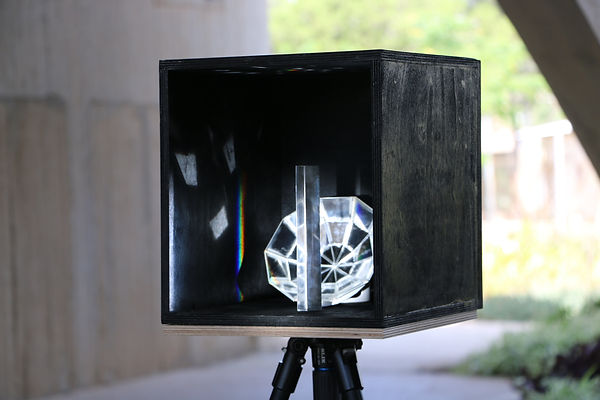
In this project we tried to give expression to the natural light resource as an element that surrounds us in our daily life and to use it for digital production. Although light is not a real substance, it is what allows us to exist in the world. Controlling the natural light from the sun will help us as humanity to design more complex structures, so that digital tools will transport natural light without the need for exposed light openings. The final presentation gave an example of a display of light and digital control, in which a concentrated beam of light hits the prism, breaks down the white light into the multitude of shades of the visible spectrum, and produces a digitally controlled colored space.